From Judgment to Recovery: Five Enforcement Routes and the Hearing Worth Booking First
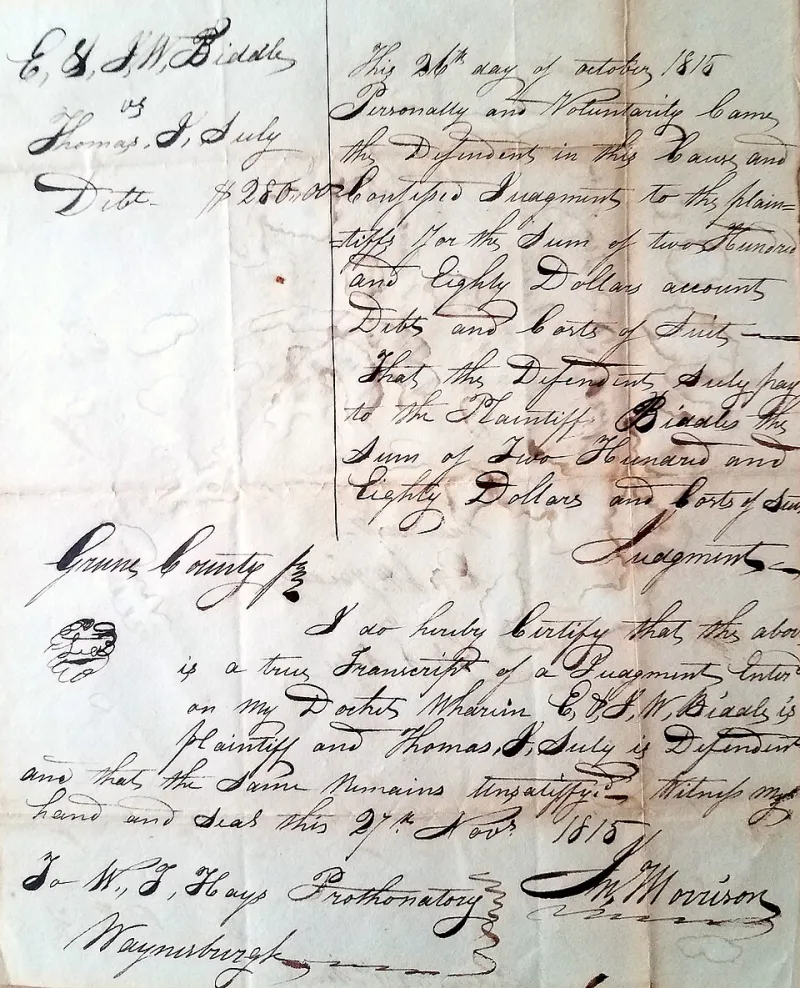
Photo: personnel of the court , Greene County, Pennsylvania, Public domain, via Wikimedia Commons
A county court judgment, usually called a CCJ, is often described as a win. For a small business, it is better understood as a ticket. It confirms the debt, but it does not transfer the money. The judgment creditor must choose an enforcement route, pay the court fee and live with the risk that the debtor has no assets, has moved or has already disappeared. In England and Wales in 2026, the routes are well established. The mistake is to treat the judgment as the end of the story, or to reach for the most aggressive remedy before finding out what the debtor actually owns.
1. The writ of control
The writ of control is the route most creditors recognise. A judgment can be transferred to the High Court for enforcement once it reaches the relevant threshold, and a High Court Enforcement Officer can then take control of the debtor's goods. The officer may attend business premises, seize stock, equipment, vehicles or other assets and sell them to satisfy the debt. The route is useful where the debtor is trading, has visible assets and is likely to pay to avoid disruption. It is less useful where the assets are leased, subject to finance, owned by a third party or essential to the debtor's trade. The officer cannot simply take everything in sight. The creditor should expect to provide information about the debtor's premises and assets, and should budget for enforcement fees and the risk of a failed attendance.
2. The third-party debt order
A third-party debt order, formerly known as a garnishee order, is aimed at money owed to the debtor by someone else. The most common target is a bank account. The court can make an interim order freezing the debt and a final order requiring the third party to pay the judgment creditor. The route is quick on its face, but the outcome depends on the account. A bank account may be overdrawn, held jointly or contain money that belongs to someone else. A customer may dispute the debt. The creditor needs evidence to show that the third party owes money to the debtor. The court fee is modest compared with some enforcement routes, but the hearing and the risk of a challenge should be factored in.
3. The charging order
A charging order secures the judgment against the debtor's land, property or shares. The court first makes an interim charging order and then decides whether to make it final. The order does not force a sale. It gives the creditor security and a route to an order for sale later. This is a patient remedy. It suits a debtor who owns property with equity but has no cash flow. It is less attractive where the property is jointly owned, heavily mortgaged or the debtor's home. The creditor should check the Land Registry title and consider whether the equity is real. A charging order can also be made against shares, but the creditor should understand the company's articles and any restrictions on transfer.
4. Insolvency
Insolvency is the pressure route. A statutory demand can precede a bankruptcy petition against an individual or a winding-up petition against a company. The threat of insolvency can produce payment where other enforcement has failed. It can also produce nothing but costs. Bankruptcy and winding up are collective processes. Other creditors may join, preferential creditors may rank ahead and the creditor may recover a small dividend. The court and deposit fees are significant. The debtor may dispute the debt, and a statutory demand can be set aside. For a small business, insolvency should be a considered strategy, not a reflex. It is most useful where the debt is substantial, undisputed and the debtor has assets or a business worth protecting.
5. Attachment of earnings
Attachment of earnings is available against an individual, not a company. The court orders the debtor's employer to deduct a sum from wages and pay it to the creditor. The route is inexpensive and can produce steady payments. It depends on the debtor being employed, having a regular income and not having priority debts that reduce the available sum. A self-employed debtor, an unemployed debtor or a company debtor cannot be reached this way. The creditor should also consider whether the debtor's employment is stable and whether the deductions will be worth the administration.
The step most creditors skip
The order to obtain information is the hearing worth booking first. It is not an enforcement remedy in itself. It is a court order requiring the debtor, or an officer of a company debtor, to attend court and answer questions under oath about income, assets, bank accounts, property, employment and business interests. The court fee is low. The hearing can be listed relatively quickly. The information can transform the enforcement decision. A creditor who is about to spend money on a writ may discover that the debtor has no goods, but has a bank account, a vehicle or an interest in property. A creditor who is considering insolvency may discover that the debtor is already insolvent or that another creditor has priority.
Small businesses often skip this step because it feels like more process rather than recovery. That is a false economy. The order to obtain information is the closest thing to a map of the debtor's finances. If the debtor fails to attend, the court can treat that as contempt, which is itself a form of pressure. The hearing can be used alongside other enforcement, not instead of it. But it should be considered before the creditor commits to an expensive route on guesswork.
Choosing the route
There is no single best enforcement method. A writ of control suits visible business assets. A third-party debt order suits a known bank account. A charging order suits property with equity. Insolvency suits a substantial undisputed debt and a debtor with something to lose. Attachment of earnings suits an employed individual. The order to obtain information suits the creditor who does not yet know which of these is realistic. The judgment is the start of the recovery decision, not the end of it.